PHP2Shell explained: two critical PHP runtime vulnerabilities
A practical, sourced explanation of CVE-2026-109618 and CVE-2026-109619: how PHP request cleanup became dangerous, which versions are fixed, and how operators can inventory, patch and investigate exposed servers.

Kareem Schultz
Technology enthusiast & systems builder · Guyana
Jump to a section
What PHP2Shell actually refers to
PHP2Shell is the name used for two critical vulnerabilities in PHP itself: CVE-2026-109618 and CVE-2026-109619. They were publicly disclosed on October 21, 2026, when the PHP project released patched versions of its supported branches. Each has a reported CVSS v4.0 score of 9.2, indicating critical severity.
The phrase does not describe a specific malicious PHP file, a WordPress plugin, or a general upload-a-web-shell technique. It describes weaknesses in the PHP runtime that can permit unauthenticated remote code execution under vulnerable configurations. That difference changes how defenders should investigate: securing an upload endpoint or updating a CMS plugin does not fix a vulnerable interpreter.
The PHP Foundation describes both flaws as problems in memory and error handling encountered by core request processing. In its October 21 advisory it says updating PHP is imperative. Security agencies, vendors and universities have also issued urgent guidance because internet-facing PHP applications are widespread.
Two CVEs, two paths to memory corruption
CVE-2026-109618 concerns corruption related to out-of-memory handling. The problem can occur when an allocation fails and PHP does not fully roll back partially initialized internal request data. Later cleanup may incorrectly treat that data as valid. The PHP Foundation confirms unauthenticated exploitation before application code runs on Apache mod_php, with remote code execution also confirmed on PHP-FPM through application-level paths.
CVE-2026-109619 concerns stale global state and a use-after-free condition. When a fatal error interrupts a cleanup path, PHP can retain references to memory that has already been released. If a later operation or request reuses that state, memory safety can fail. The PHP Foundation reports demonstrated code execution against a real application running on Apache mod_php.
The useful mental model is not a recipe for constructing a malicious request. It is the trust boundary between externally supplied HTTP input, the request parser, worker memory and cleanup. When error handling leaves invalid state behind, later operations cannot safely assume that internal objects are valid.
| Identifier | Underlying issue | Potential impact |
|---|---|---|
| CVE-2026-109618 | Out-of-memory handling and partially initialized request state | Remote code execution and process instability |
| CVE-2026-109619 | Stale global state and use-after-free after fatal-error cleanup | Remote code execution, crashes and memory exposure |
Why this was especially serious for web servers
The affected behavior is inside the PHP interpreter rather than one business application. PHP can run behind Apache mod_php, PHP-FPM and other SAPIs, and it is used by content management systems, frameworks, custom code and embedded appliance interfaces. An operator may have a modern-looking front end that still relies on an older PHP worker behind the scenes.
Apache mod_php was highlighted as especially exposed because some processing paths can be reached without an application-specific authorization check or a matching application route. This does not mean every PHP deployment has identical exploitability, but it means application-level guards cannot be assumed to protect the runtime.
A vulnerability affecting web-serving PHP is distinct from a standalone command-line installation that never accepts requests. Inventory both, but prioritize the components actually processing untrusted web traffic and the privileges those processes possess.
Affected and fixed branches
The PHP project published fixed releases on October 21, 2026: PHP 8.5.12, 8.4.27, 8.3.36 and 8.2.35. Install at least the fixed release on your supported branch, preferably the latest vendor-supported security update. PHP 8.1 and older branches are end-of-life and need an upgrade path; source-only backports and downstream support arrangements should not be confused with ordinary supported PHP releases.
Linux distributions may backport patches without matching upstream version strings. For packaged PHP, consult the distribution advisory and build/changelog; for containers, inspect the image digest and rebuild or replace the container. Hosted or appliance PHP may require a vendor-specific firmware or platform release.
| PHP branch | Minimum upstream fixed version | Action |
|---|---|---|
| 8.5 | 8.5.12 | Upgrade within the supported branch |
| 8.4 | 8.4.27 | Upgrade within the supported branch |
| 8.3 | 8.3.36 | Upgrade within the supported branch |
| 8.2 | 8.2.35 | Upgrade and review branch end-of-life |
| 8.1 and older | No regular supported release | Migrate or obtain documented vendor-supported backport |
Find the PHP runtime that is actually serving traffic
The first response step is an inventory. Check web hosts, containers, virtual machines, appliance management panels and managed platforms. Look at the running web-service integration rather than assuming the output of a single php -v command represents every interpreter on a host.
A host can have one PHP version in the command-line PATH and another used by PHP-FPM pools or Apache. Record the relevant service, the binary location, version and package source, worker privileges, public exposure and the owner responsible for patching it.
These commands are simple local inventory examples for an authorized administrator. They do not test exploitation and cannot alone certify that a service is patched.
Patch, restart and verify
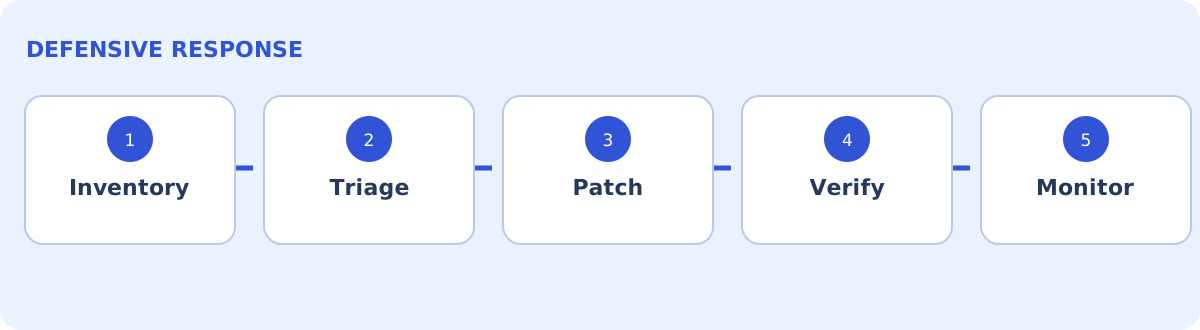
Schedule the change urgently according to exposure. Preserve a backup and recovery plan, apply a fixed PHP runtime package or vendor release, and restart or reload the web-serving processes so that vulnerable workers are replaced. Confirm that the running service—not merely the installed package—has the fixed build or documented backport.
A web application may need a compatibility check across extensions, CMS modules, PHP-FPM settings and framework versions. A proper patch validation includes application health checks, error logs, and a check that old worker processes and outdated containers are no longer accepting traffic.
Temporary measures such as a WAF, limiting public access, adjusting upload-progress behavior or turning off certain optimizations may reduce risk for specific paths but are not complete substitutes for updating PHP. Any temporary settings should follow the PHP advisory and be independently tested for operational impact.
- Identify every internet-facing or externally reachable PHP worker and its owning team.
- Apply the upstream fixed release or a vendor-confirmed patch/backport.
- Reload or replace running workers and verify the version in active use.
- Check application behavior and vendor/component compatibility after the update.
- Preserve remediation evidence: change record, package/build, host inventory and verification results.
Look for signs that the server was already affected
Patching closes the known vulnerability path but does not undo a compromise that may have occurred earlier. The University of Toronto advisory recommends investigating hosts that were unpatched after October 20. Other reporting describes attempted exploitation before public release. The correct response is to preserve useful evidence and evaluate whether suspicious activity is present.
Monitor PHP and web server errors for abnormal memory exhaustion, fatal-error bursts and unexplained worker crashes. Review access logs for unusual multipart request patterns or spikes. Inspect web roots and writable directories for newly introduced PHP files, verify that plugins and scheduled jobs have expected provenance, and examine endpoint telemetry for unexpected child processes or outbound connections.
Not every memory error or multipart request is malicious. Correlate evidence across time, hosts, reverse proxies and service processes. If a compromise is suspected, isolate the asset, preserve logs and forensic material, rotate exposed credentials under incident-response guidance and involve the responsible security team before making destructive changes.
- Unusual PHP worker exits, memory exhaustion or fatal-error patterns.
- Abnormal multipart request volume and repeated requests to unrelated PHP routes.
- Unexpected files in the document root, writable directories or plugin paths.
- PHP or web-server accounts launching unapproved tools or reaching unusual network destinations.
- New persistence artifacts: modified tasks, accounts, startup configuration or scheduled jobs.
Where infrastructure automation helps the response
Ansible can help a team collect versions and apply a tested configuration or patch to an approved inventory of hosts. Python can normalize inventory results and produce a clear exception report. Terraform or OpenTofu can show how managed infrastructure or container resources were provisioned, but an infrastructure plan is not evidence of the PHP build actually running in a worker.
Keep the detection and remediation workflow separated: gather inventory and logs first, present a proposed action for review, apply changes with limited privileges and verify the active service afterward. Preserve a history of the exact package, image or vendor patch used. No published playbook should silently push a destructive change to unknown systems.
A visual workflow can help document responsibilities, but this problem still depends on timely vendor fixes and operator verification. The best automation makes that process safer, traceable and repeatable—not less accountable.
Final takeaway
PHP2Shell is a reminder that serious application exposure can originate in the runtime beneath the application itself. It is not enough to audit the visible login form, upload endpoint or CMS version if the interpreter processing requests is vulnerable.
Update the runtime, verify the running service, investigate possible earlier activity and keep enough records to show what changed. That approach is more durable than relying on a temporary workaround or an apparently clean dashboard.
Sources & further reading
These links provide the technical basis for the article. Check upstream advisories and documentation for revisions.
- PHP Foundation — October 21 security release(opens in a new tab)
- PHP project — 2026 release archive(opens in a new tab)
- PHP security advisory — CVE-2026-109618(opens in a new tab)
- PHP security advisory — CVE-2026-109619(opens in a new tab)
- Cyber Security Agency of Singapore — PHP2Shell alert(opens in a new tab)
- University of Toronto — Response and threat hunting(opens in a new tab)
- Ubuntu — PHP2Shell patched packages(opens in a new tab)